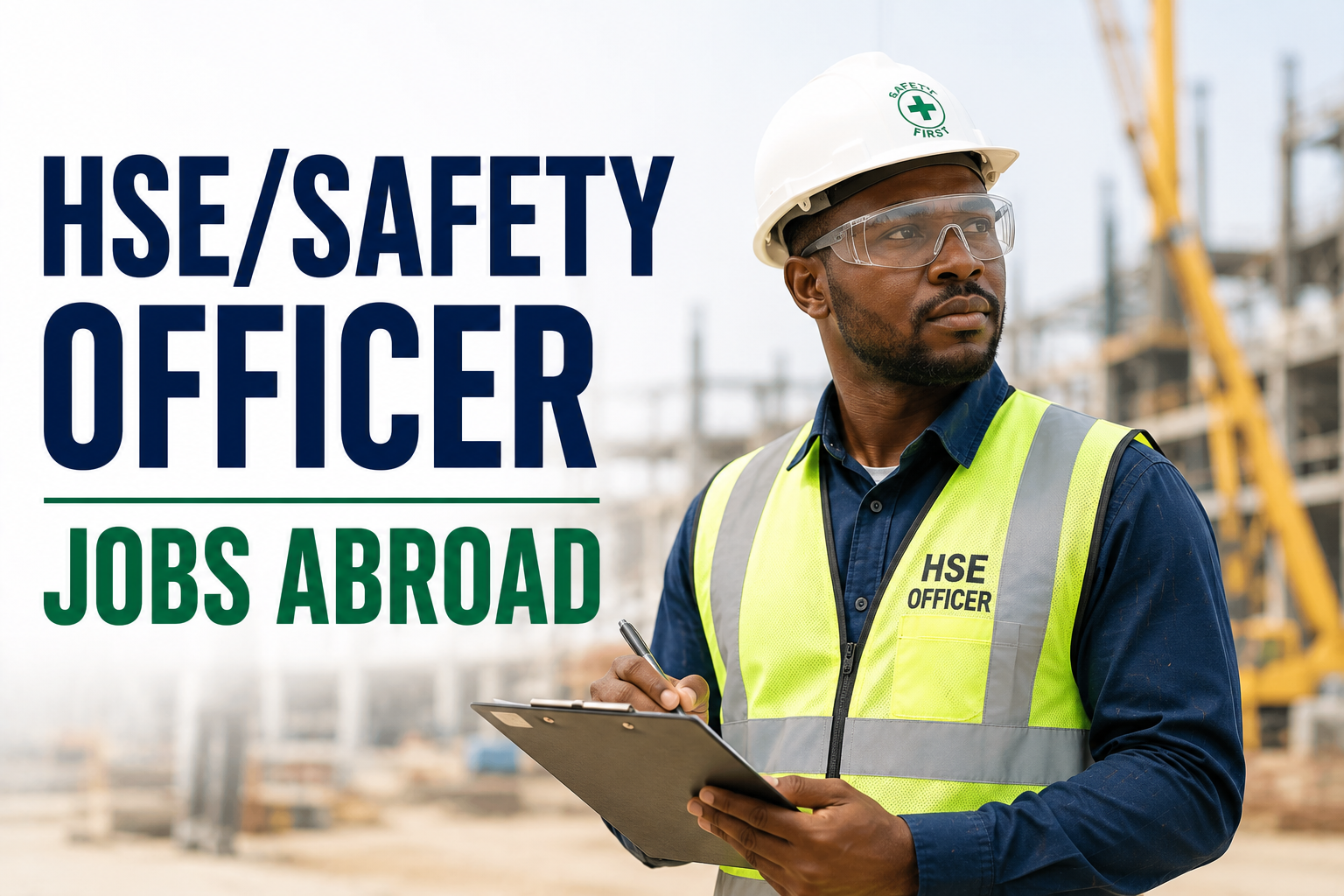
Safety officer roles are a strong path abroad for anyone with construction site experience and an eye for process and documentation but this is a career where the right certification for your target market matters more than almost any other trade covered in this series. Get the credential mismatched to the market, and even a strong CV underperforms. This guide breaks down exactly what NEBOSH, IOSH, and OSHA each mean, where each one carries weight, and what recruiters are genuinely screening for.
The Three Credentials, and Why They’re Not Interchangeable
NEBOSH (National Examination Board in Occupational Safety and Health)
- NEBOSH is UK-based but functions as the closest thing to a global standard. The NEBOSH International General Certificate (IGC) in particular is widely treated as the entry credential for international safety roles, especially in the UK and in international EPC (engineering, procurement, construction) environments. It also meets the academic requirement for IOSH Technical Membership, which is worth knowing if you’re planning to build toward both.
IOSH (Institution of Occupational Safety and Health)
- IOSH is a UK-based professional body, and IOSH Managing Safely is one of its most common entry-level qualifications. It’s faster and cheaper to obtain than a full NEBOSH IGC, which makes it a reasonable starting point or supplementary credential, but it’s important to be realistic here: IOSH Managing Safely alone is generally not enough to land a dedicated safety officer role in competitive markets. Treat it as a stepping stone toward NEBOSH IGC, not a substitute for it.
OSHA 30 (Occupational Safety and Health Administration)
- OSHA 30 is the standard reference credential for the US, and it’s specifically recognized on US and US-affiliated construction projects globally. If your target market is the US, OSHA 30 is close to a baseline expectation, especially for construction-specific roles, with the Certified Safety Professional (CSP) credential often preferred for more senior positions.
Match the Credential to the Market, Not the Other Way Around
This is the most important piece of advice for this trade specifically: don’t collect certifications and hope they transfer. Research your target market’s actual job postings first, then pursue the credential that market asks for.
- UK roles: typically list NEBOSH, IOSH, or SMSTS (Site Management Safety Training Scheme), often alongside construction-specific NEBOSH variants
- US roles: frequently require OSHA 30 as a baseline, with CSP preferred for senior safety positions
- Canada: while not covered by NEBOSH/IOSH/OSHA directly, the Canadian Registered Safety Professional (CRSP) designation is the closest domestic equivalent worth researching if Canada is your specific target
- Australia: safety qualifications typically run through the national VET (Vocational Education and Training) system and WHS-specific certifications, distinct from the NEBOSH/IOSH/OSHA framework used elsewhere
What Recruiters Screen For Beyond the Certificate
The certification gets your CV past the first filter, but experienced hiring managers are looking for more than a credential list:
Documented site experience, not just classroom qualification.
- A safety officer role is about applying knowledge on a real and active site such as inspections, toolbox talks, incident investigation, permit-to-work systems. A CV that’s heavy on certifications but light on actual site time consistently underperforms at the interview stage, regardless of how impressive the credentials look on paper.
Communication skills.
- This surprises people entering the field, but a meaningful part of the day-to-day role is communication such as delivering toolbox talks, writing clear inspection reports, and having the standing to tell a crew or even a supervisor to stop work when something’s unsafe. Recruiters probe for this directly in interviews, often by asking how you’ve handled pushback from a crew or site manager in the past.
Familiarity with the specific regulatory environment
- Know specific regulatory environment you’re entering, not just general safety principles. Being able to speak specifically to permit-to-work systems, incident reporting structures, or fall protection standards relevant to your target country signals real readiness, not just theoretical knowledge.
A Realistic Path Into the Role
Step 1: Identify your target market first, and look at several real job postings for that market specifically to see which credential is actually being requested.
Step 2: Start with the credential that matches like NEBOSH IGC for UK/international EPC work, OSHA 30 for US-focused roles, or the relevant local equivalent for Canada or Australia.
Step 3: Build documented site experience alongside certification, not after it. Even informal experience like inspections, safety meetings, incident reports you’ve contributed to, is worth documenting specifically rather than left as a vague line on your CV.
Step 4: If IOSH Managing Safely is your starting point, be honest with yourself about it being a stepping stone, and have a clear plan to progress to NEBOSH IGC or the equivalent for your target market.
Step 5: Once you have an offer, the sponsorship process follows the same country-specific route as any other trade, covered in our Canada and UK/Europe guides.
Conclusion
Safety officer roles reward precision about which market you’re targeting and which credential that market respects such as NEBOSH and IOSH for the UK and international EPC work, OSHA for the US, and country-specific equivalents for Canada and Australia. Combine the right credential with real, documented site experience and strong communication skills, and this becomes one of the more accessible supervisory-track roles to build a career around abroad.
Related Reading
- Construction Jobs Abroad for Nigerians: Full List of In-Demand Roles
- Skilled Trade Jobs Abroad: What Employers Actually Want
- Documents, Certifications, and Trade Tests You Need Before Applying for Construction Jobs Abroad
- Construction Jobs in Canada: How LMIA and TFWP Sponsorship Really Works