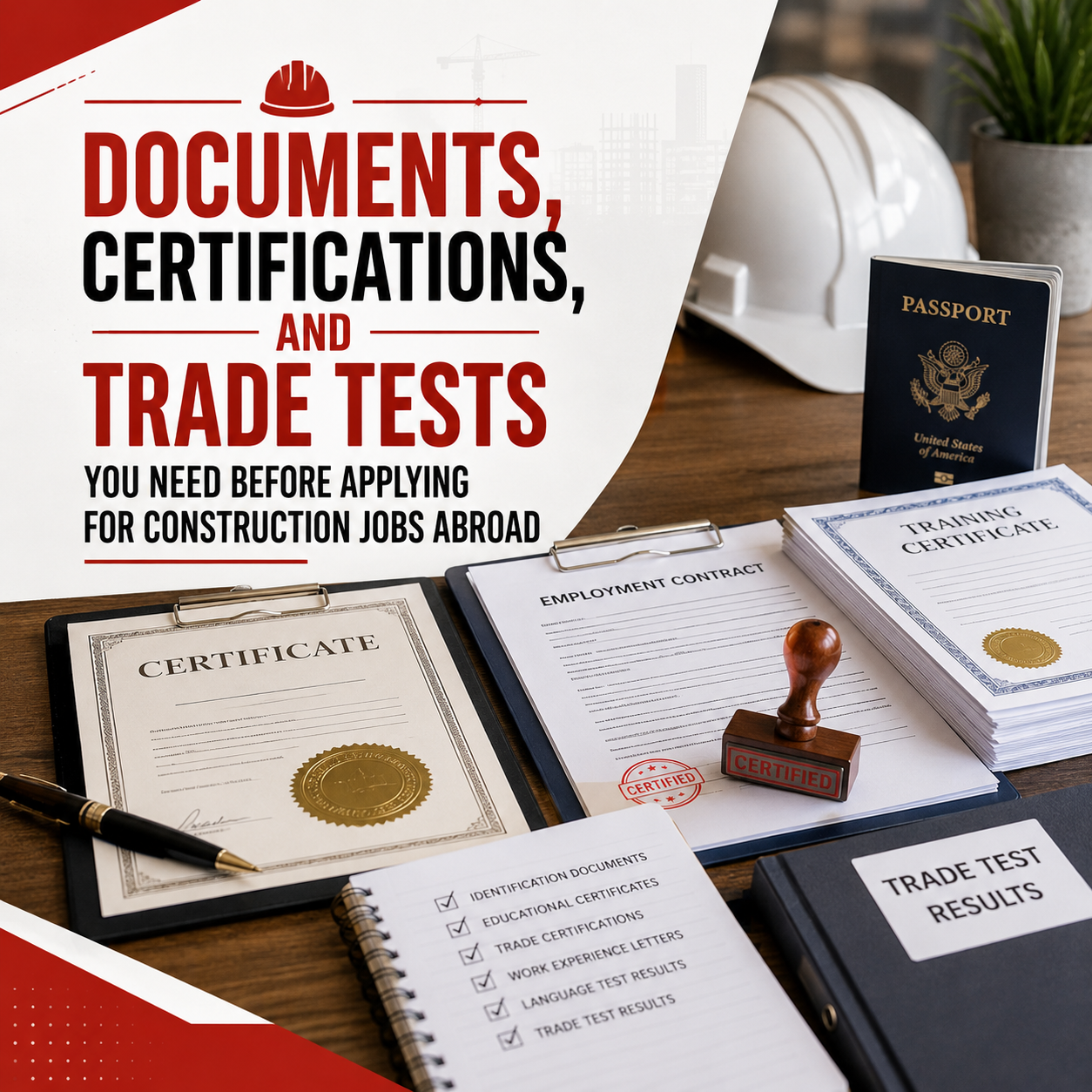
One of the biggest reasons genuine applications stall isn’t a lack of skill, it’s missing or incomplete paperwork. Employers in Canada, the UK, and Germany all need to see specific, verifiable proof of who you are and what you can do before they’ll move forward with sponsorship. This guide walks through exactly what to gather, country by country, so you’re not scrambling for documents after an offer comes in.
The Documents Almost Every Country Will Ask For
Before getting into country-specific certifications, these are the basics worth having ready regardless of where you’re applying:
- A valid passport, with enough validity left to cover the application and work period
- Trade certificates or diplomas from your training, plus any apprenticeship completion records
- Reference letters from past employers, ones who can actually be contacted and will confirm your work history if asked
- A police clearance certificate, often required as part of background checks for work permits
- Medical examination results, where required — some countries require this only after a job offer, not before
- A clear, honest CV listing your specific trade experience, not just general “construction worker”, specificity here matters more than most people expect
Canada: What You’ll Need
Beyond the general documents above, Canadian sponsorship often comes down to how well your experience is documented and, in many trades, whether you’re working toward Red Seal certification, the national standard that lets a tradesperson’s qualification be recognized across provinces. If your trade is regulated, expect your credentials to be assessed against Canadian standards, and be prepared that you may need to take additional certification steps even with strong experience already in hand.
Practical checklist:
- Trade certificate or documented equivalent experience
- Reference letters that clearly state your role, duration, and specific duties
- Any existing certification numbers (welding tickets, electrical licenses, etc.) translated if not in English or French
UK: The CSCS Card Is Non-Negotiable
This is the part most “jobs abroad” content skips entirely, and it’s one of the most important pieces for the UK specifically: almost no UK construction site will let you on-site without a valid CSCS card (Construction Skills Certification Scheme). It’s not optional, and it’s not just a formality, it’s the actual gatekeeping credential for the entire industry.
The card color you’re eligible for depends on your qualification level:
- Green card: entry-level, general labor, requires only a Level 1 Health and Safety award plus a CITB test pass
- Blue card: for skilled tradespeople with an NVQ Level 2 (or equivalent) in their specific trade, this is the standard card most experienced workers should be targeting
- Gold card, supervisory level, requires NVQ Level 3
- Black card: management level, requires NVQ Level 6/7
To get almost any card, you’ll also need to pass the CITB Health, Safety and Environment test which is a straightforward multiple-choice exam, but one you do need to prepare for and pass within two years of your application.
If you’re coming from abroad with real experience but no UK-recognized qualification, don’t panic — there’s a route for that too: you can apply for an Experienced Worker (Red) card while working toward an NVQ through on-site assessment, meaning you can start working while you formalize your UK qualification.
Practical checklist:
- Determine which CSCS card level matches your experience before you apply for roles
- Book and pass the CITB Health, Safety and Environment test
- If you have overseas trade experience but no UK NVQ, ask prospective employers about the Experienced Worker route rather than assuming you’re not eligible
Germany: Recognition is the Whole Game
Where the UK gatekeeps through the CSCS card, Germany gatekeeps through qualification recognition. Your foreign trade certificate isn’t automatically valid, it has to be formally compared to the equivalent German qualification by a recognition authority (commonly the ZAB, or your trade’s relevant chamber, such as the IHK).
This process takes three to four months, so the biggest mistake you can make is waiting until you have a job offer to start it. Some employers offer a “Recognition Partnership,” letting you begin working while the assessment is finalized but that only helps if you’ve already started the paperwork.
Practical checklist:
- Start the recognition process as early as possible, ideally before you’re actively job hunting
- Gather detailed records of your training and work history, the more specific, the easier the comparison process
- Ask any prospective employer directly whether they offer a Recognition Partnership
Trade Tests: What to Expect
Beyond paperwork, some employers and certification bodies will ask you to demonstrate your skill directly, especially for specialized trades like welding. This can include a practical skills assessment, a written trade knowledge test, or both. If you’re applying for a role like welding, ask early what kind of test to expect, process type (MIG, TIG, arc), materials, and certification standard can all vary by country and even by individual employer.
A Simple Way to Stay Organized
Keep every document including
- certificates
- reference letters
- police clearance
- test results
…in one digital folder, scanned and clearly labeled, before you start applying anywhere. Employers and immigration processes move faster when you can produce what’s asked for immediately, and having everything ready signals seriousness in a space where many applicants show up underprepared.
Conclusion
Genuine sponsorship in Canada, the UK, and Germany depends heavily on documentation that’s specific to each country’s system like Red Seal alignment in Canada, a CSCS card in the UK, and formal recognition in Germany. None of it is complicated once you know what’s actually required, but all of it takes time to prepare. Start early, be specific rather than generic in how you document your experience, and treat the paperwork stage as seriously as the job search itself, because in practice, it’s often the deciding factor.
Related Reading
- Construction Jobs in Canada: How LMIA and TFWP Sponsorship Really Works
- Construction & Trade Jobs in the UK and Europe: Skilled Worker Visa Routes Explained
- How to Avoid Job Scams When Applying for Construction Work Abroad
- Construction Jobs Abroad by Salary: Comparing Pay Across Roles, Canada, Australia, UK & US